
Riftbound Gameplay & Design Feedback
State of the game

Intro
For those of you who don’t know me, I’m George. I travelled to China to play Riftbound early and won a Regional there as well as Top 8ing another, Chongqing and Guangzhou respectively. Since coming home I finished Top 8 in Houston, and I’ve top cut every single day of all but one major Riftbound event I participated in. CCS PPG SCG etc etc etc. I took home my second win at SCG two weekends ago. I guess I’m also becoming known for my sometimes critical takes on the game. This is a long read — particularly important UNDERLINED points of feedback can be clicked to navigate to the suggestions section at the footer where I try to provide my best attempt at solutions. If you have a short attention span you can just scroll to the bottom to see my suggestions.
Combat, Deflect & True Dilemma
A true dilemma in logic is a valid argument form presenting two, and only two, exhaustive and mutually exclusive options which lead to undesirable outcomes.
You might have seen my “Riftbound has a problem” tweet where I wrote at length about some issues in Set 1 of Riftbound that I thought might persist into Set 2. My concerns were the high stakes and seemingly mandatory nature of creature to creature combat — contradicted by the design of low energy cost cards that negate combat or make the outcome incalculable very early in the game.
Might in Hand?
In high-level Riftbound you often don’t really have a choice but to attempt combat as early as Turn 2. This means you’re getting your 4-5 card hand checked very early in the game. Even when only considering on-rate combat tricks which add 1-2 might per energy the quality of your hand often matters immensely here. Sometimes you would calculate for Discipline and instead be hit with a crushing 2x Engarde to defend Grove or Tree. This is card games, maybe stakes shouldn’t be so high on a near mandatory Turn 2 combat, but… In the end this is card games.
The prevalence of these situations is due to what I think is a deceptively simple factor — Too much might resides in hand relative to the creatures on the board. It takes until turn 3 to naturally play a creature who can overcome the stats you gain from a 1 energy Punch First. Powerful interaction is a key to skill expression, but the current ratio of Potential Might in Hand : Visible Might on Board is too disparate.
Finding the right ratio will take time, but some of the Set 2 cards completely disrespected the value of balancing the two.
Beyond Adjusting Might
With the rise of Annie in Set 1 we saw the power of some of the purple cards which negate combat entirely for 2 mana. This worried me enough to post my initial feedback. But, with some long term improvement to the card pool I suppose I could come to love this game.
In Set 2 things got worse…
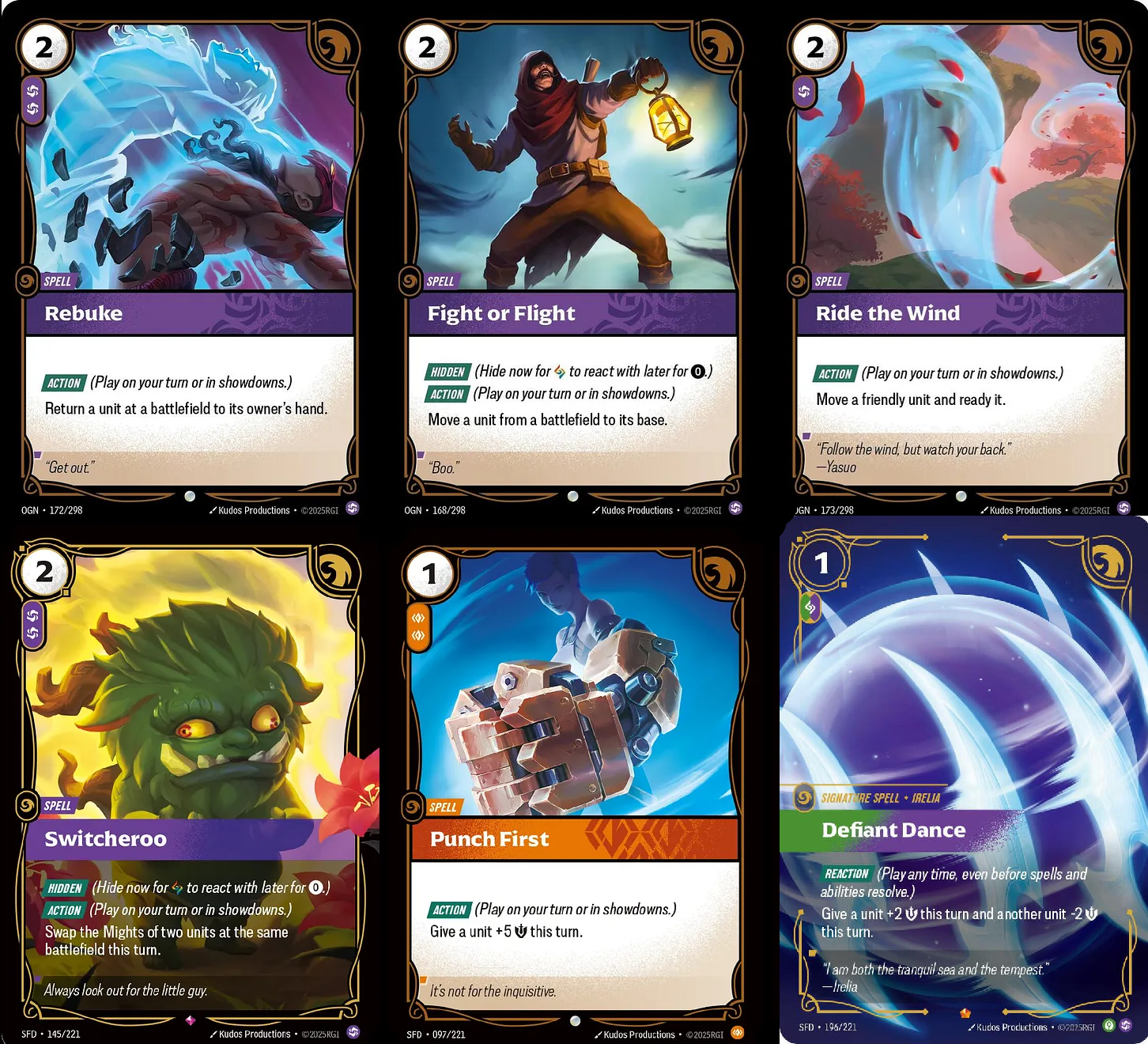
Purple got three powerful leaders and a turbo package that seems designed for 2026 Yu-gi-oh. In addition we got even more cards that just say “No” to combat at extremely low energy costs. I’m often asked what I would ban to help the Set 2 Metagame and I’m not able to easily answer just a few cards. I think this entire archetype of cards is a burden on the game. These cards all cost significantly too little energy, and for some ungodly reason two of them have the Hidden keyword.
In high level Riftbound, your turn begins with the thought “How do I remove my opponent from their battlefields?” These cards invariably trade up in energy, sometimes massively, when you attempt to do so. If you decide to send two creatures, to attempt to play around them, then Ride the Wind will often end the game on the spot instead.
To consider the balance of these cards ask yourself or the best player you know:
”How much damage does Voidseeker need to do to be one of the best cards in the game?” “6?” “7?” “8?” “How much to see play at all?”
We have a problem.
Deflect, and Kaisa in Set 1
So if you’re often forced to risk the game too early by engaging in combat how can you circumvent this? By playing the Spellslinger archetype obviously. So along came Kaisa to secure a spot for most of Set 1 as the community perceived BDIF.
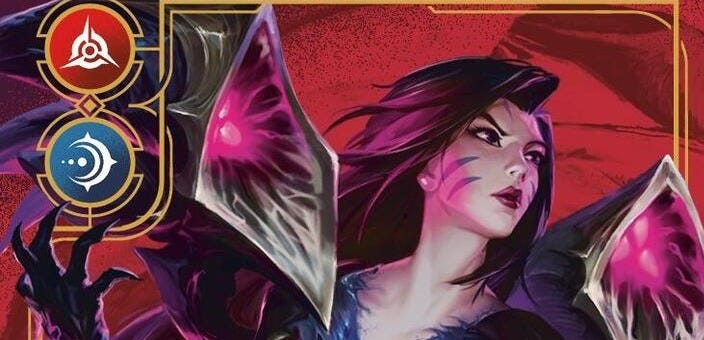
If you were the best player in the room, this deck simply made the most sense to bring into what was being piloted. High agency midrange options with the ability to opt out of the all-too-volatile nature of Riftbound’s combat system by using powerful spells instead.
The meta slowly warped around Falling Star, people learned not to tap out with 3 small creatures(lol), and Kaisa mirrors were mostly skill expressive early on. The world was at peace. Then a horrible event took place — You might think I’m going to complain about Aurora or any number of things here, but no…
What happened was that the Red Poro entered Reaver’s Row. You can’t force this little guy to do combat cause he runs away and you can’t shoot him cause he has Deflect. This line resulted in really high variance mirror games. In Master Yi, the Obelisk Catalyst Deadbloom Zhonyas line was discovered. These two lines play out differently, a high variance race favoring the first player vs a slow near certain death — but the cause of the problem is the same root.
Deflect.
On the key early turns in Riftbound, Deflect is far closer to Hexproof than it is to a genuine choice. It’s so harshly punishing to even target one of these creatures with a spell, that if they don’t die as expected the game often ends on the spot. This is not an exaggeration.
I could write extensively about might adjustments effectively negating damage spells with less restrictions and greater speed and what this means for the volatility of game states, but instead I’ll focus on where the problem is most egregious. Adding Deflect takes this flaw and creates almost comical board states where people end up with 1-2 runes remaining.
Anyway, I had hope Set 2 would fix these pro… Oh god.
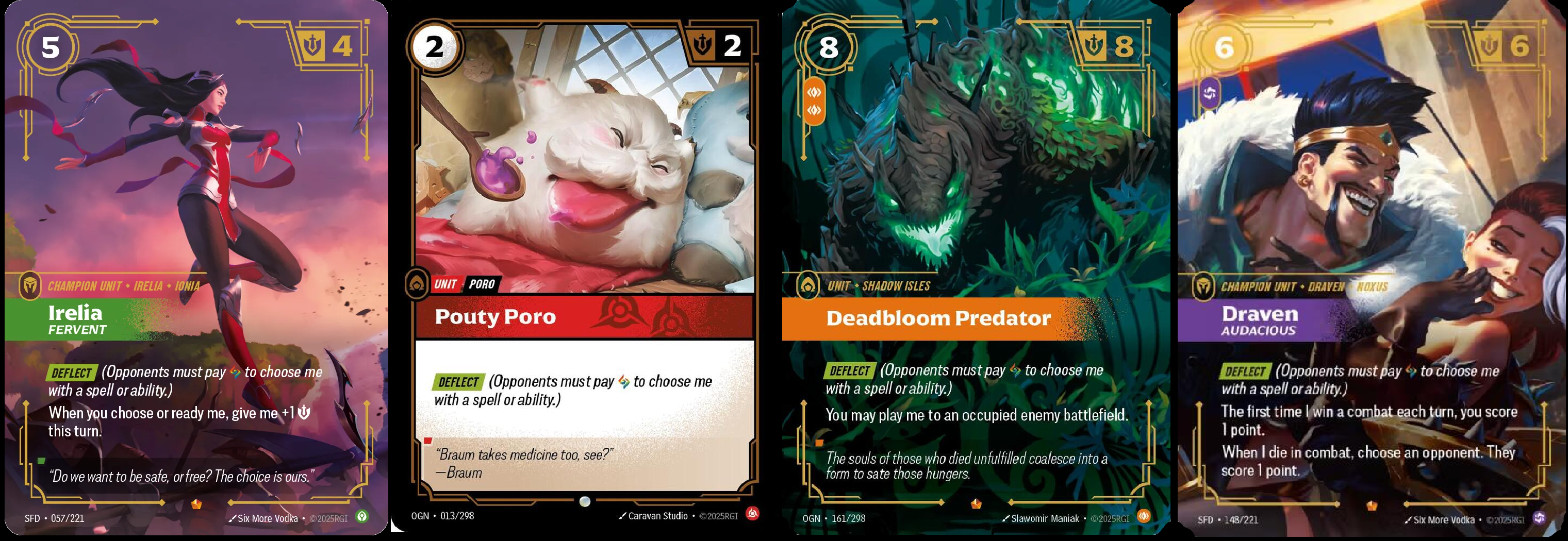
It genuinely seems that designers took every creature they wanted to be powerful, and smacked a free Deflect onto it.
The designers might say Deflect is intended to discourage damage based removal. But it’s not merely discouraging it in practice — it’s essentially preventing it from being used at all. What’s worse is you can instead try to do combat, but that’s also asking for a tempo crushing punish with the current game design. There are entire color combos where opposing Irelias are functionally immortal.
Watching the designers functionally errata Deflect to make it even MORE powerful when it’s responsible for two of the worst TURN TWO board states in Set 1 was… Sad?
Icathian rain killing a unit for 4 power is okay. Repeat spells doing their full power on a Deflect unit without paying twice is fine. Deflect isn’t the glue holding the game together in the face of overpowered removal — in Set 2 it’s a crack in the hull that’s hated damage spells out entirely.
This matters because alternatives to combat help keep decks “honest.” If the alternative is rendered unviable by a common keyword deck building becomes about stacking powerful tricks. See Draven and Irelia.
Free Cards & the Power System
I’m somewhat of an outsider to TCGs, but there’s something I’ve heard dozens of times from card game veterans. Free, costless, or virtually costless cards are always a problem. Set 2 of Riftbound brought with it countless options to play things for free.
I’ll state something that’s close to a fact — then I’ll share a more subjective opinion.
1. Free cards are hard to balance and design around.
&
2. The turns in Riftbound Set 2 are already out of hand.
I think these are both massive issues. This isn’t just a Set 2 problem though. Riftbound from the beginning has had a problem with the implementation of free or discounted creatures.
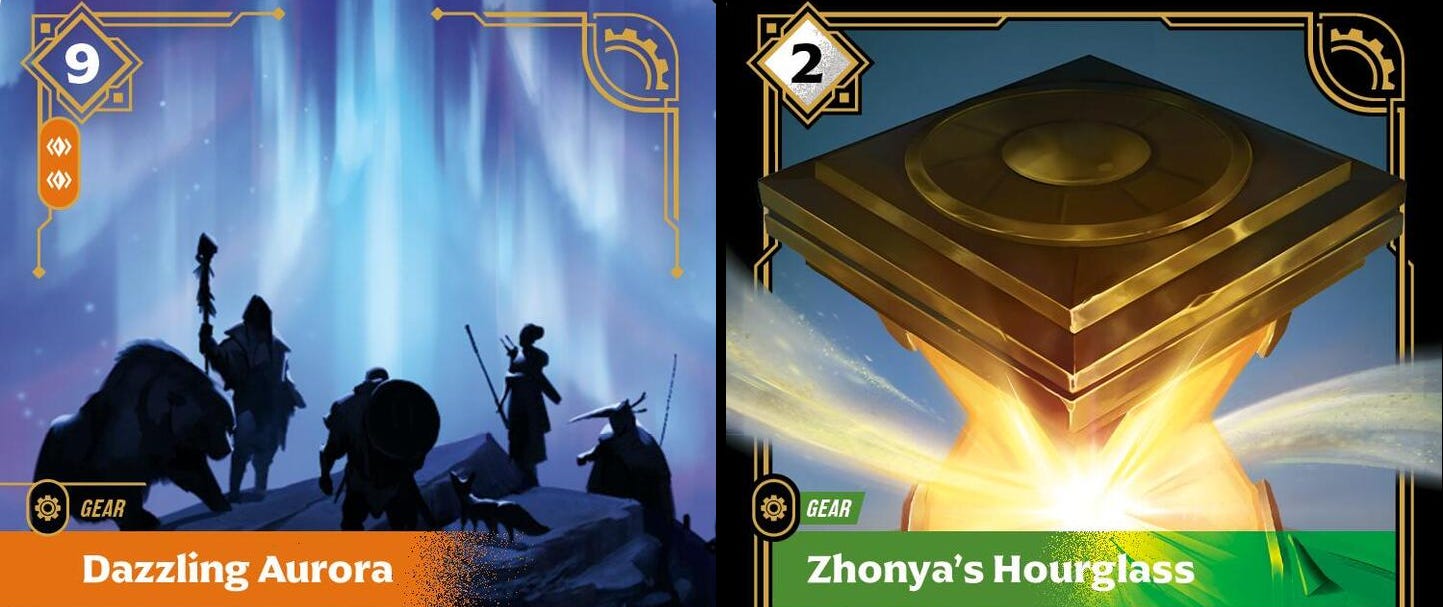
Let’s start with Zhonya’s Hourglass:
How much should respawning a creature cost? Probably something close to the average playable creature cost. Respawning a powerful creature would net you energy, and having your respawn wasted on a small creature would hurt a bit. My rate, if I had to choose one for this effect would be around 4 energy.
How much is definitely too cheap? 1 power 0 energy hidden with the rules changing to allow you to save anything you want.
On Dazzling Aurora:
This card is frankly a design disaster. Why does it cost basically the same as the creatures it generates?
Why in Set 1 did the designers not simply make this card cost 12? We narrowly (partially) dodged one of the most degenerate Set 1 Metagames in TCG history. Wouldn’t it be the humble thing, if it was necessary somehow to print this card in Set 1, to be careful with it. This is something worthy of direct criticism, and I’m sorry for the way that I know it comes across, but it’s the truth.
This card will remain the best way to put large creatures into play until it rotates. All large creatures in its color pairs will have to be balanced around being printed each turn for roughly 9 cost instead of 12.
Miracle Stuff
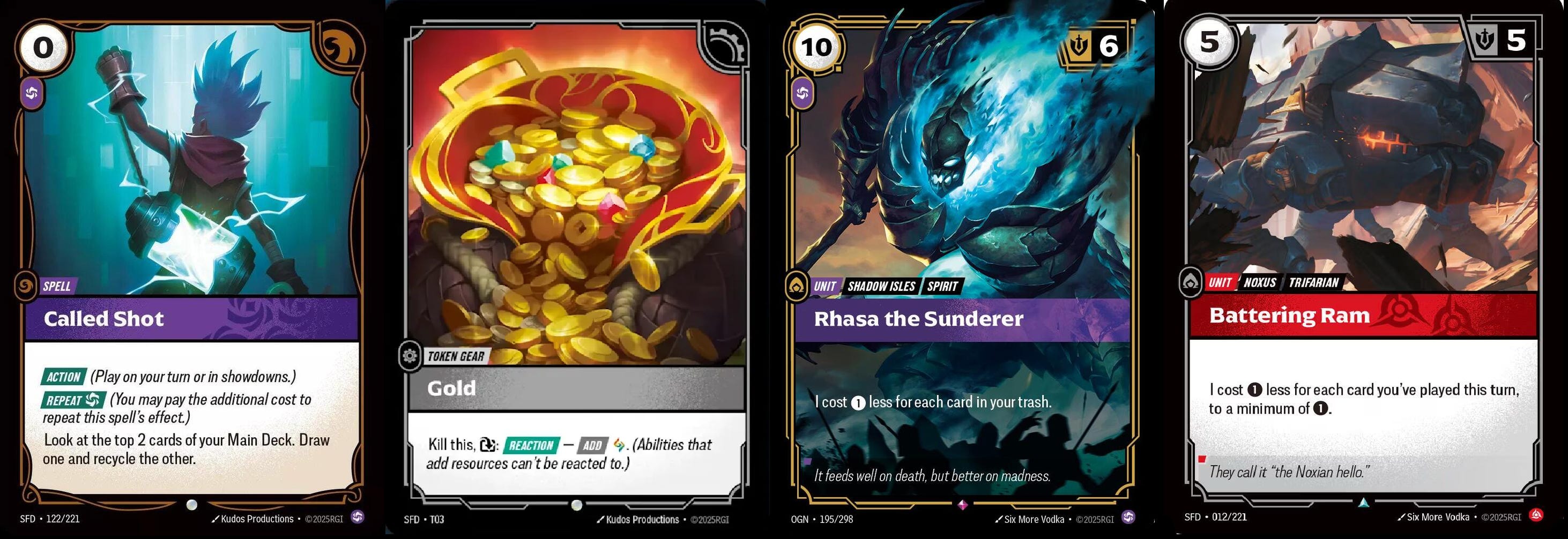
Then we have the Miracle decks —Keeping it real here, I don’t know if these engines are too powerful or not, but they’re playing a different game entirely in only Set 2. These guys are playing Yu-gi-oh 2026 and most decks are playing Mechanical Chaser. What takes years of power and mechanic creep seems to have happened in Riftbound in a tenth of the time I’ve heard countless players express that this is not what they signed up for — I am inclined to agree. With the upcoming article from Riot about the state of the game I hope they make clear how Riftbound is intended to play.
The hidden mechanic needs to be used carefully, cost reductions like Purple Ezreal the Ram, Rhasa, and even Gold require caution and finesse to balance. Caution that seems entirely absent from the design approach of Set 2. I understand the desire to make fun cards and I love powerful interaction, but things are already a bit out of hand.
These cards and concepts come with design restrictions — All purple cards must now be balanced around an absolutely absurd level of access to the deck. In the same way we talked about all expensive creatures being balanced around Aurora this design restriction is too much too early, and I cant imagine long term it’s worth the payoff. In fact I consider the payoff so far to be a pretty bad gameplay experience. Time was already an issue in Set 1, incredible resource disparity was already a problem in Set 1, and outlier high roll lines were already a major problem in Set 1. While I wont pass judgement on whether or not Miracle Draven or Ezreal are the best decks, they certainly exacerbate all of these issues.
The Power system & Gold
Power cost doesn’t balance cards like Punch first or Rebuke because they win the game the turn they’re played. absolute cards like this need a higher energy cost, not power
- Collin Kaiser
The power system in Riftbound has potential to be its greatest asset. In set two it was used and abused in a way that’s become perhaps the games greatest detriment. Shifting some of a card’s budget to power allows for design flexibility. Shifting too much, in the case of certain card types, creates problems.
For one, reading your opponents intentions from their remaining mana is a big part of skill expression in TCGs. Too many of the viable power cards read exactly the same off 2 mana. What the deal with all these 2 energy pieces of interaction that are incredibly impactful at different power costs? Making reads must be more viable.
The more power your deck uses instead of energy the less energy you need. Who cares if you spend down to 4 runes hiding cards after spending energy on the penultimate turn if you can still cast 3 Rebukes on the final turn.
Gold made this problem significantly worse. High gold games feel absurd, with both players taking high powered actions while effectively saving up runes to be cashed in for even more massive high power spends on the penultimate and ultimate turns.
The potential for these issues will be ever-present within the design framework of Riftbound — And they exist everywhere in Set 2.
Duds, the Price of “Playing Fair”
There’s a lot of decks in Set 1 of Riftbound that aim to circumvent the Midrange game entirely. I want to talk about why that’s a choice people are making, and why it’s so effective within the framework of Riftbound’s design.
There’s one concept in particular I want to hone in on here. Two factors from earlier in this article are relevant here.
High Stakes of early combat especially going second.
The disproportionately powerful Turn 2s and beyond often enabled by costless cards.
A lot follows from these two realities:
Firstly, this means you have but one turn of advantage playing your midrange line curving out with creatures.
This means you better not miss your turn one.
This means you play 8-9 two cost creatures.
This means 23% of your deck on every turn for the rest is now these small creatures with often weak text and 1-2 Might.
It’s easy to imagine the design problem here. Whatever advantage results from this configuration of creatures has to be massive to justify this weakness — thus the creatures have to be weak in the current framework.
That’s a whole can of worms.
Suggestions:
My direct suggestions to the designers to improve the game in the long term are as follows:
Reducing the volatility of combat:
When combat tricks are “absolute” they must have a higher energy cost. This means Fight or Flight Rebuke Switcheroo and Ride the Wind are not meant to be 2 energy cards.
Reduce the stakes of combat. Think twice when printing mechanics like Grove of the God Willow, Draven Leader, Purple Draven, and others which further catastrophize failed combats.
Cards which solve combat absolutely against one creature are too powerful to have the hidden text.
Consider might restrictions on all future Rebuke style cards — more lenient gusts are okay — a lack of any restrictions at all does not seem to fit with the way these cards are costed currently.
Avoid overkill — Defiant Dance did not have to be Punch First for less power AND at reaction speed. (Punch first itself is probably too powerful.)
Consider card design which shifts some combat might from the hand to the board — might should primarily reside on creatures. At least endeavor to make the distribution more equal than it is currently.
Long term, Ride the Wind must go or scoring rules must change. This is probably the harshest most direct suggestion. There’s a good reason for that.
Deflect and making damage spells work:
The % of playable cards in the game that functionally negate damage spells is far, far too high as a result of the speed disparity and targeting restrictions.
Cards like not so fast are salt in the wound or the nail in the coffin for damage spells. The main problem is the ease of access to might adjustment.
Consider the power level of Deflect. This keyword is far and away too powerful for how it’s budgeted in Riftbound. From the Pouty Poro to the new Irelia these cards or the keyword need to be looked at.
The best vector for balancing what’s already done is probably ANOTHER errata to make Deflect a once per turn effect.
If none of these seem agreeable damage spells need to overkill stuff by like 150% to become playable. This ties into the might on hand vs board issue. Use-rate outside of Set 1 Kaisa is already near 0%. We’re talking about a whole card archetype here.
Consider alternatives to power-creeping spells. Perhaps Riftbound with it’s single combat-stat design needs to be a game where you target at resolution. Maybe more might buffs should be action speed.
Free Cards & Power costs:
Not much to say here. This problem is mostly caused by outlier cards.
It’s important to look at the allocation of the hidden keyword much more carefully.
Higher power costs shouldn’t change the energy budget for spells to the extent it does. Primal Strength good Punch First bad.
Based on how Set 2 is going I would strongly reconsider the implementation of cost reductions. Please never print a card with a 0 in the top left corner again. Sorry for this bluntness.
Consider how gold is implemented and how it affects the budget allocated provided by a “power.” 1 Gold = 1 Hidden card on the board. Edge of Night spawns cause you made a gold. I don’t envy the people balancing around this.
Avoid allowing power costs to obfuscate the “power level” of opponent’s options to the extent it does. It’s impossible to read the difference between a Rebuke, Ride the Wind, and Fight or Flight — Try to avoid this where possible by giving cards with vastly different power levels different energy costs.
Improving Two Drops/Deck Structure:
Long term increase the might floor of two drops to 2-3 so they become irrelevant more slowly.
Consider the budgeting philosophy for cards like Punch First. 1 Energy = 3 dead 2 drops and failed combat. I understand the idea here, but the discrepancy is too great.
Taper down the might of top-end creatures.
Give these small creatures, and creatures in general more powerful effects. Purple got some good ones this set. So did Yellow.
Reconsider creature keyword budgeting. Vision =/= Deflect. The keywords are far from equal.
Consider weakening “combos” or “high rolls” to allow for more flexible mulligan rules. I understand well why it’s two cards currently.
Make creatures in general more powerful relative to might adjusting spells and gear.
My recommendation at this time is the urgent consideration of a somewhat unorthodox Limited/Restricted/Banned list. I’m well aware of the problems with limiting cards, but I feel the problems are too widespread to target with bans. You can see how rapidly sentiment toward the game has soured among top TCG players. Riftbound was incredibly hyped, but it can’t and doesn’t need to sustain this negativity.
Being honest Draven leader is the least of our worries in the long term. Excuse my ego but I’m certain other people will come to understand this as well. All my love to the designers — you’re breaking boundaries and setting records and I know making a game is not easy. Nevermind a game that tries new things to the extent Riftbound does. ❤️
To put it briefly: You're right.
But I remain hopeful.
I've played a lot of TCGs over the years and I've seen this play out a few times.
Set1 is a showcase of rules and mechanics, Set2 is building more on the showcase. By Set3 or 4 the game turns around towards a more balanced direction, because they now had time to react to feedback on Set1.
So, this kind of feedback is vital, especially early on.
The game is young and immature, but I'm hoping they take feedback like yours and we see it's effects by Set3.
This puts into words very well lots of my current feelings and worries about the future. Hopefully Riot sees this feedback recognizes these current issues with the state of the game. I love this game and hope only for its success.